
In a world of confusion, cynicism, and rejection of the supernatural, where can I find the
TRUE HISTORICAL CATHOLIC FAITH?
What happened to the Church?
Since the Second Vatican Council (1962–1965), the Catholic Church has seen significant change. Many faithful have noticed shifts in traditions, reverence, and teachings that once defined the faith across the globe. For those who grew up with the rich heritage of the Church, today’s practices may feel unfamiliar.

Reflecting on the Shift
What brought about these changes?
Vatican II introduced reforms aimed at modernizing the Church. Yet, for some, these adjustments raise questions about the continuity of Catholic teachings. Did these changes enhance the faith or move it away from its timeless roots?

Holding to the Unchanging Faith
For centuries, the Church preserved traditions and teachings that united Catholics worldwide. While much has evolved, the treasures of the faith remain accessible for those seeking deeper connection to its rich heritage — a heritage celebrated by saints and grounded in truth.

Rediscover and Reflect
We invite you to explore an essential question:
Can truth evolve with the times?
Join us in rediscovering the profound, unchanging beauty of the Catholic faith as practiced for generations. Whether you’re reconnecting with tradition or simply seeking clarity, this journey offers timeless inspiration.
Latest Videos:

Summary of the presentation
A crisis is felt as unprecedented and spiritually dark.
Dan Davis frames the post–Vatican II situation as a rupture: novelty over tradition, compromise over orthodoxy, and “rights of man” displacing the rights of God. He argues that the present Roman leadership has become a source of confusion rather than a rule of faith.The central diagnosis proposed is sedevacantism (“the chair is vacant”).
He defines sede vacante as the claim that the Chair of Peter is unoccupied because the post–Vatican II claimants are not true popes. He stresses this is presented as a theological conclusion aimed at preserving Catholic faith, not as forming a new religion.He distinguishes “bad popes” from “heretical popes.”
His core theological move is:a pope in mortal sin can still be pope,
but a public heretic cannot be pope because heresy places one outside the Church.
He frames sedevacantism as “theologically certain,” not dogma.
He appeals to degrees of theological certitude, arguing his conclusion is strongly compelled by Catholic principles, while conceding that salvation does not require one to adopt the label or even the position explicitly.He responds to common objections (his “top 10”), emphasizing these themes:
“Sedes are Protestant/heretics/schismatics” is dismissed as largely slogan-level argumentation; he flips the charge toward the Novus Ordo’s Protestantizing tendencies.
“Nothing changed at Vatican II” is treated as un-debatable without basic goodwill and curiosity.
“Vatican II was only pastoral” is attacked as misleading, pointing to documents styled as “dogmatic constitutions.”
“You have no authority to declare the See vacant” is answered as personal discernment for self-preservation, not a juridical act on behalf of the whole Church.
“Gates of hell prevailed” is flipped: if heresy truly conquered the papacy, then the promise would be void; therefore the heretical claimant cannot be pope.
“Where is the visible Church?” is answered: the Church persists visibly in those who hold the faith whole and entire and maintain valid sacraments, even amid the mystery of a prolonged vacancy.
He critiques “Recognize-and-Resist” as incoherent.
He argues it functionally elevates lay commentators above the pope by making them the arbiter of which papal teachings must be resisted, undermining the papacy’s purpose as the proximate rule of faith.He critiques the “Cassiciacum/material-formal thesis” (while affirming charity).
He treats it as an attempted workaround that becomes strained when it attributes limited papal faculties to a non-pope, while still urging practical charity toward clergy aligned with it.He offers an explanation for why nearly no bishops publicly broke at Vatican II:
He proposes three factors:precedent (many leaders historically fail under pressure),
obedience (a deep expectation that Rome “cannot” defect),
diabolical subtlety (errors seeded in ambiguous formulations, difficult to detect without hindsight).
He closes with a strong call to personal sanctity and charity.
He insists doctrinal clarity matters, but warns against losing spiritual peace, and emphasizes works of mercy, humility, and fidelity amid crisis.
Key quotes (verbatim from the transcript)
“Something is broken. Something unprecedented and dark.”
“Novelty has replaced tradition. Compromise has replaced orthodoxy. The rights of God have been usurped by the rights of man.”
“The chair of Peter is vacant.”
“Sedevacantism is not a church… It is a theological position of the Catholic faith.”
“Mortal sin… still inside the church… Heresy… places one outside of the Catholic Church.”
“Pastoral councils don’t produce dogmatic constitutions.”
“The first see is judged by nobody.”
“The visible church is all around us in those who hold the Catholic faith whole and entire. It just lacks a pope, which is a mystery known only to God.”
“Don’t let the noise of the social media steal your spiritual peace.”
“I would rather feel compunction than know how to define it.” (attributed to Thomas à Kempis)
Key takeaways (from a traditional sedevacantist Catholic point of view)
The transcript’s strongest “sedevacantist” contribution is the distinction between sin and heresy. Historically, the Church has endured morally corrupt popes; the claim here is that the present crisis is categorically different because it concerns doctrinal rupture and public, persistent errors touching faith and morals.
The speaker’s most consistent principle is that the papacy exists to end doctrinal uncertainty, not multiply it. Hence his critique of “recognize-and-resist”: if the pope’s doctrinal acts can be routinely “screened” by laymen (or pundits), then the papacy’s function as proximate rule of faith is functionally displaced.
He treats the long vacancy as a painful providential mystery, not an argument against the position. From this standpoint, an extended interregnum is extraordinary, but less contradictory than asserting that Christ’s Church can be governed by a man who publicly contradicts prior magisterial teaching.
He insists on moral and spiritual priorities. Even while pressing a hard doctrinal thesis, he ends by prioritizing sanctification, works of mercy, humility, and interior peace—an important corrective to the temptation toward bitterness, factionalism, and internet-driven outrage.
Conclusion
From a traditional sedevacantist Catholic perspective, the transcript is essentially an argument that the post–Vatican II religious establishment cannot be treated as a normal “bad era” of Catholic history, because the crisis is presented as one of doctrine, worship, and ecclesial identity, not merely personal corruption. Its internal logic is straightforward: if the Church is indefectible and heresy cannot be imposed upon the universal faithful as Catholic doctrine, then a public program of doctrinal novelty and Protestantizing reform cannot be reconciled with a true pope’s office; therefore, the most coherent Catholic response is to hold fast to what the Church has always taught and practiced, even if that fidelity requires acknowledging an unprecedented vacancy and living through the hardship of it.
At the same time, the speaker ends where a sober Catholic must end: fidelity is not only an argument—it is a life. In an age when many are tempted to substitute outrage for sanctity, he rightly recalls that God will judge not our online victories but our faith, hope, charity, humility, and perseverance. If this crisis is permitted as a chastisement and a test, then the “remnant” response must look like the saints: clarity without pride, firmness without cruelty, separation from error without hatred of persons, and a daily return to prayer, the sacraments, and works of mercy—so that, whatever happens in Rome, we remain unmistakably Catholic before God.

Summary
This in-depth interview with Bishop Donald Sanborn, superior general of the Roman Catholic Institute, covers a broad range of theological, ecclesiastical, and practical issues facing the Catholic Church today, particularly focusing on the crisis following Vatican II and the ongoing debate surrounding sedevacantism—the belief that the post-Vatican II popes are not true popes. Bishop Sanborn discusses the nature and role of the laity, the papacy, traditional Catholic teaching on obedience and resistance, the theological legitimacy of the current popes, and the state of tradition and the sacraments within the Church. He emphasizes the primacy of the Catholic faith and doctrine over individuals occupying ecclesiastical offices and insists on the necessity of maintaining continuity with past Church teaching to preserve the Church's indefectibility. The conversation also delves into the practical realities of traditional Catholic communities, missionary work, and the prospects for a future true pope. Bishop Sanborn critiques the Vatican II reforms and the modern liturgical changes as breaks from tradition, suggesting a "great reset" is needed, including the suppression of modernist innovations and a return to traditional liturgy and doctrine. Finally, he addresses the growth and challenges of the sedevacantist movement and offers pastoral advice for welcoming newcomers while maintaining doctrinal rigor.
Highlights
Bishop Sanborn explains the theological basis and implications of sedevacantism, emphasizing that the faith itself must remain inviolate even if the occupant of the papal office does not.
The interview clarifies the traditional Catholic teaching on obedience to the pope, including when and how resistance is permissible, highlighting distinctions between personal heresy and formal teaching errors.
The bishop critiques the post-Vatican II Church reforms, particularly the Novus Ordo Mass, as doctrinally flawed and incompatible with traditional Catholic faith.
He discusses the crisis of jurisdiction and authority in the Church, explaining the difference between sacramental jurisdiction and ordinary jurisdiction, and how the latter is currently lacking in faithful bishops.
Bishop Sanborn addresses misconceptions about the infallibility and indefectibility of the Church, clarifying that popes are protected from teaching error in faith and morals but are not infallible in all aspects.
The conversation touches on the practical work of the Roman Catholic Institute in preserving tradition, catechizing new faithful, and ministering globally despite limited resources.
The bishop offers a vision of how a true pope might be elected in the future by a faithful remnant of cardinals, preserving apostolic succession and orthodox doctrine.
Key Insights
The Supremacy of Faith Over Ecclesiastical Office: Bishop Sanborn insists that the Catholic faith and doctrine are supreme even over the pope. The pope is subject to the faith, not above it, and must adhere strictly to it. This theological principle underpins sedevacantism, which holds that if a pope publicly defects from the faith, he ceases to be pope because the Church cannot teach error. This insight challenges mainstream Catholic assumptions and underscores the critical importance of doctrinal continuity for the Church’s identity and salvation.
Obedience and Resistance to the Pope: Traditional Catholic teaching demands obedience to the pope in faith, morals, and discipline, but this obedience is not blind or unconditional. Resistance is legitimate if a pope commands something contrary to faith or morals, but such resistance does not extend to judging or deposing him; only a legitimate authority like the College of Cardinals can do so. This nuanced position balances respect for papal authority with doctrinal integrity and helps clarify the traditionalist stance on the crisis.
Limits of Papal Infallibility: The bishop clarifies that papal infallibility applies strictly to definitive teachings on faith and morals, protected by the Holy Ghost, but popes can err in prudential decisions or historical facts. This distinction counters misunderstandings that portray the pope as an oracle or infallible in all statements, emphasizing a more precise theological understanding of magisterial authority.
Crisis of Jurisdiction and Authority: Bishop Sanborn explains that while valid holy orders and apostolic succession remain intact, the true ordinary jurisdiction (the authority to govern) is effectively absent because modernist popes and bishops do not preserve the faith. Traditional communities operate under supplied jurisdiction, an emergency provision allowing them to administer sacraments without official authority to govern. This insight exposes the depth of the institutional crisis and the practical challenges faced by faithful Catholics.
The Novus Ordo Mass and Vatican II as Doctrinal Breaks: According to Bishop Sanborn, the Novus Ordo Mass and Vatican II reforms represent a rupture from traditional Catholic liturgy and doctrine, effectively promulgating a false religion within the Church’s structures. He argues that simply tolerating these changes for the sake of unity or access to the Latin Mass is inadequate and dangerous. This strong critique highlights the theological and liturgical battleground at the heart of the crisis.
The Church as Visible but Contaminated: Bishop Sanborn uses the metaphor of a building infested with vermin to describe the current Church hierarchy. The institutional structure (the “skeleton”) remains, but it is compromised by heresy and apostasy at the leadership level. However, the true faith and sacraments are preserved in pockets of resistance. This ecclesiological insight helps explain sedevacantists’ position that the Church is present but suffering a grave internal crisis.
Hope and Strategy for the Future: Despite acknowledging the crisis and limited numbers, Bishop Sanborn emphasizes hope grounded in perseverance, faith, and divine providence rather than demographic optimism. He envisions a future where faithful cardinals might break from the modernist hierarchy to elect a true pope, restoring doctrinal clarity and authority. The pastoral approach to newcomers stresses catechesis, charity, and doctrinal integrity, recognizing the necessity of building up the faithful in an era of confusion.
Conclusion
Bishop Donald Sanborn’s interview offers a comprehensive and theologically rich perspective on the crisis in the Catholic Church, focusing on the papacy, sedevacantism, and the preservation of tradition. His analysis is rooted in traditional Catholic doctrine and magisterial teaching, emphasizing the primacy of faith over ecclesiastical authority and the necessity of doctrinal continuity. He provides clarity on complex issues such as papal infallibility, obedience, resistance, and jurisdiction, while also addressing practical realities faced by traditional communities. The interview is an invaluable resource for understanding the theological foundations and pastoral implications of the ongoing crisis and the hopeful path forward for those committed to preserving the Catholic faith.
Latest Articles:
Summary
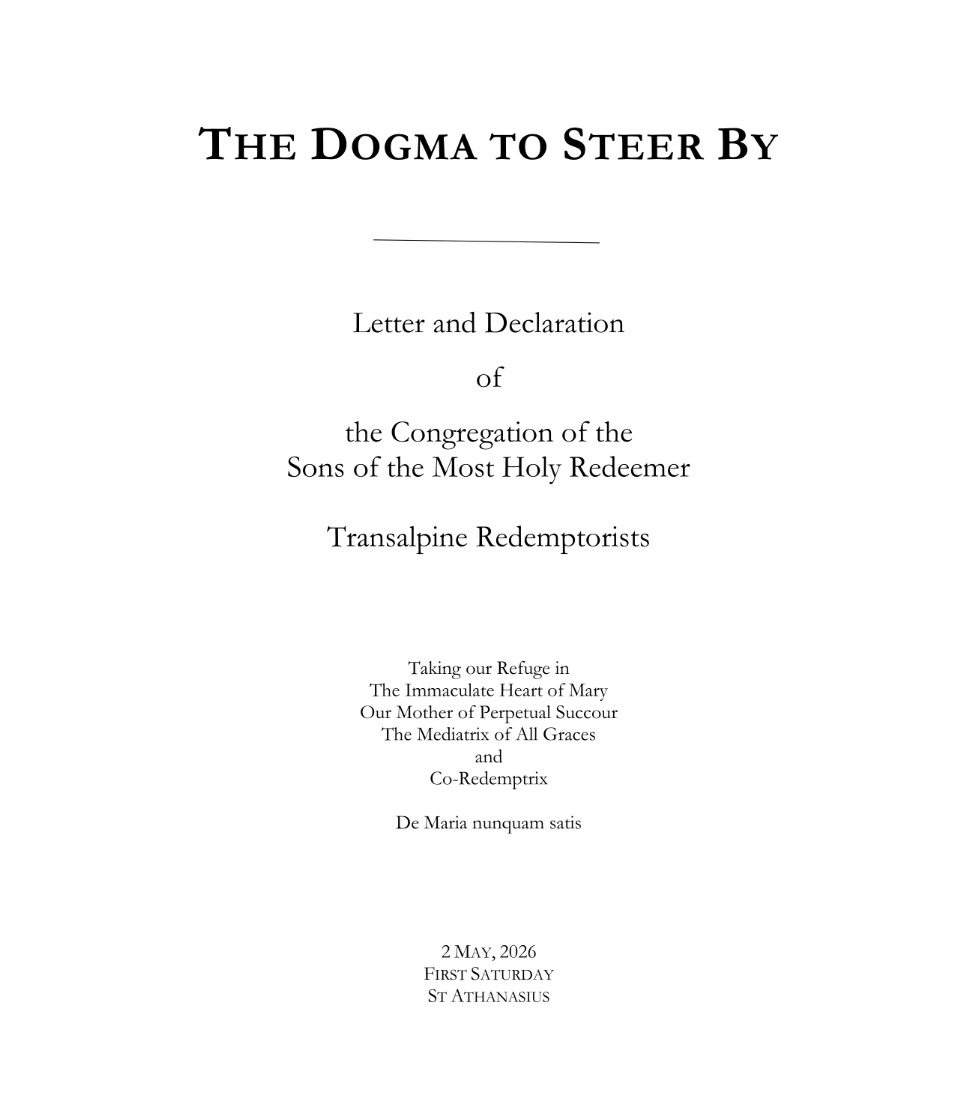
The Dogma to Steer By is a letter and formal declaration issued on 2 May 2026 by the Congregation of the Sons of the Most Holy Redeemer, also known as the Transalpine Redemptorists. It represents a decisive change in the congregation’s position: it rejects the legitimacy of the post–Vatican II papal claimants and abandons the traditionalist “recognise and resist” position that it had followed after its 2008 reconciliation with Rome.
1. Central diagnosis
The document argues that the contemporary institutional Church has been progressively infiltrated and overtaken by Modernists who outwardly retain Catholic offices, buildings and terminology but profess a different religion.
It presents this infiltration as a long historical process beginning before Pope St Pius X, developing through seminaries and the clergy, and reaching its decisive triumph at the Second Vatican Council.
The authors connect this alleged transformation with:
Modernism;
Freemasonry;
religious indifferentism;
religious liberty;
ecumenism;
alleged Communist infiltration of seminaries.
The text repeatedly distinguishes between the indefectible Catholic Church and what it calls the “official,” “Conciliar” or “Vatican II Church.”
2. The principal doctrinal issue: religious indifferentism
The document’s central theological concern is the proposition that different religions may be legitimate paths to God or salvation.
It contrasts pre–Vatican II papal condemnations of indifferentism with:
Nostra Aetate;
Dignitatis Humanae;
Unitatis Redintegratio;
the interreligious meetings at Assisi;
John Paul II’s reported kissing of the Quran;
the Abu Dhabi document on Human Fraternity;
the Pachamama controversy;
Francis’s 2024 remarks in Singapore;
statements attributed to Leo XIV.
The congregation concludes that the post-conciliar approach is not merely ambiguous or imprudent but directly contradictory to the previous papal magisterium.
3. The “dogma to steer by”
The document’s controlling theological premise is a passage from the First Vatican Council:
“This See of St Peter always remains unimpaired by any error.”
From this the authors formulate the following syllogism:
The See of Peter cannot teach religious error.
The post–Vatican II claimants have publicly taught religious error.
Therefore, they cannot have been legitimate occupants of the See of Peter.
The document says this is not a formal canonical deposition or juridical judgment. It calls it a “judgement of faith and practical necessity.”
This is the principal basis for its sedevacantist conclusion.
4. Rejection of “recognise and resist”
A particularly significant aspect of the declaration is its rejection of the position commonly associated with Archbishop Marcel Lefebvre and much of the traditionalist movement: recognising the reigning claimant as pope while resisting his teachings, disciplines or liturgical reforms.
The authors argue that a Catholic cannot consistently:
recognise a man as the Vicar of Christ;
refuse his doctrinal teaching;
reject his disciplinary authority;
reject the liturgy promulgated under his authority.
They now regard their own 2008 reconciliation with the Roman hierarchy as a mistake because it required them simultaneously to recognise and resist that hierarchy.
5. Practical consequences
The congregation declares that it will:
give no juridical recognition to Leo XIV or his bishops;
refuse communion with the “Conciliar” hierarchy;
continue offering the traditional Roman Mass;
adhere to the pre–Vatican II papal magisterium;
encourage faithful Catholics to seek priests outside the Conciliar structure;
form independent traditional Catholic communities;
work towards an “Imperfect General Council.”
The proposed council would consist of bishops whom the congregation considers to have retained the Catholic faith. Its task would be to examine and pronounce upon the status of the current papal claimant and his post–Vatican II predecessors.
6. Formal declaration
The declaration’s formal conclusions include the following propositions:
Enemies had infiltrated the Church before Vatican II.
Vatican II taught principles previously condemned as indifferentism, false ecumenism and religious liberty.
Paul VI through Leo XIV contradicted the pre–Vatican II magisterium.
The apparent popes since Vatican II produced a spiritual catastrophe.
Post-conciliar doctrinal, moral, liturgical and disciplinary decisions cannot be accepted.
Acceptance of Vatican II’s allegedly false teachings separates a person from the Catholic Church.
Recognising a pope while resisting his doctrinal and disciplinary authority is untenable.
The declaration is signed by the congregation’s priests and religious, whose signatures appear on pages 10 and 11.
Selected quotations from the authors
On the nature of the crisis
“The Modernist presence within the structures and hierarchy of the official Church has gone beyond critical mass to a near saturation point.”
— Page 2
“From the outside they look to be Catholics, but they do not profess the Catholic Faith as taught through the centuries.”
— Page 2
“We must stand firmly with the Catholic Church and move well away from the camouflage of its counterfeit.”
— Page 2
On Vatican II
“Our spiritual French Revolution came. It came at the Second Vatican Council.”
— Page 3
“The documents of Vatican II reject the condemnation of Indifferentism and ignore the constant teaching of Church.”
— Page 3
On the document’s central theological argument
“If the See of Peter were to teach error, then beyond any possible doubt, the person teaching that error is not a Catholic Pope.”
— Page 4
“And if he is not a Catholic Pope, he is no Pope at all.”
— Page 4
“We are not making a canonical judgement — only the Church can do that. But we are making a judgement of faith and practical necessity.”
— Page 4
On separation from the post-conciliar hierarchy
“We must move away from all cooperation with those who have abandoned the Faith and therefore the Church.”
— Page 5
“We must give no juridical recognition to those who have departed from it, including Leo XIV and his bishops.”
— Page 5
“You must find priests who offer the traditional Mass, who teach the traditional Faith, who reject the heresies of Indifferentism, Ecumenism, and Modernism.”
— Page 5
On the congregation’s previous position
“There has been a great mistake on our part to think that the hierarchy of the Novus Ordo was sufficiently Catholic for us to operate under its command.”
— Page 9
“That mistake was the fruit of nearly 20 years of living the non-Catholic stance of recognising but resisting those whom we thought were the authorities of the Church.”
— Page 9
“Recognition of the destroyers of the Faith and any submission to them at all is both impossible and endangering one’s Faith.”
— Page 9
Final statement of continuity
“Our statement is new. Our perspective has changed. But our Faith has not changed.”
— Page 9
“Holding the True Faith of our Fathers, we will continue to offer the True Mass.”
— Page 9
Important historical and theological quotations reproduced in the document
The document also relies heavily on older papal and theological sources.
Pope St Pius X, Pascendi Dominici Gregis
“The partisans of error are to be sought not only among the Church’s open enemies; they lie hid … in her very bosom and heart.”
— Quoted on pages 2 and 13
“They lay the axe not to the branches and shoots, but to the very root, that is, to the faith and its deepest fibres.”
— Quoted on pages 2 and 13
Pope Gregory XVI, Mirari Vos
“This perverse opinion is spread on all sides … that it is possible to obtain the eternal salvation of the soul by the profession of any kind of religion.”
— Page 15
“Without a doubt, they will perish forever, unless they hold the Catholic faith whole and inviolate.”
— Page 15
Pope Pius IX, Qui Pluribus
“Also perverse is the shocking theory that it makes no difference to which religion one belongs.”
— Page 15
“They remove all distinction between virtue and vice, truth and error.”
— Page 15
Pope Leo XIII, Humanum Genus
“They thereby teach the great error of this age … that all religions are alike.”
— Pages 15 and 20
“The Catholic religion … as it is the only one that is true, cannot … be regarded as merely equal to other religions.”
— Pages 15 and 20
First Vatican Council
“This See of St. Peter always remains unimpaired by any error.”
— Pages 4, 8 and 16
St Alphonsus de Liguori
“If the Pope were ever to fall into heresy as a private person, then he would immediately fall from the papacy.”
— Page 16
Pope Pius XI, Mortalium Animos
“The Apostolic See cannot on any terms take part in their assemblies, nor is it anyway lawful for Catholics either to support or to work for such enterprises.”
— Page 20
Overall significance
The document is not simply a criticism of Vatican II or of particular papal actions. It is a formal adoption of a sedevacantist position by the Transalpine Redemptorists. Its decisive claim is that the contradiction it perceives between the pre-conciliar and post-conciliar magisterium can only be resolved by concluding that the post–Vatican II claimants never possessed, or ceased to possess, legitimate papal authority.
Its most consequential sentence regarding the congregation itself is:
“Our statement is new. Our perspective has changed. But our Faith has not changed.”
That sentence encapsulates the document’s purpose: to present the congregation’s change of juridical and ecclesiological position as a consequence of preserving, rather than altering, its Catholic faith.
Watch their interview on Kokx News here.

Introduction
Fr. T. J. Ojeka’s “Discerning the True Church in a Time of Apostasy” is a practical guide for Catholics navigating today’s ecclesial eclipse. Beginning with a vivid “two paths” image—an attractive, synodal “conciliar” complex versus a humble chapel—the author argues that Vatican II birthed a counterfeit religion outwardly wearing Catholic signs but animated by Modernism. He frames the solution as a supernatural grace: the Holy Ghost’s Gift of Discernment, exercised according to Scripture, St. Thomas, St. Ignatius, and the perennial rule of faith (St. Vincent of Lérins). The essay ends with concrete steps: study pre-Vatican II teaching, avoid “una cum” and the Novus Ordo, pray, suffer, persevere.
Key quotes
“We live in a time of ecclesiastical eclipse… a false religion wearing Catholic vestments—an impostor church, born from the errors of Vatican II.”
“Discernment of Spirits… is a supernatural gift… perfects the virtue of prudence and illuminates the intellect.”
“Vatican II is the French Revolution in the Church.” — Card. Suenens
“This Council… a new Church which they themselves call the ‘conciliar Church.’” — Abp. Lefebvre
“The true faith is that which has been believed everywhere, always, and by all.” — St. Vincent of Lérins
Key messages (≈250 words)
Discernment is indispensable and supernatural. The gift of discerning spirits, taught by St. Ignatius and explained by St. Thomas, enables souls to distinguish what is from God, nature, or the devil—especially when error appears in pious dress (2 Cor 11:14). It perfects prudence and guards against enthusiasm or credulity.
Scripture and Tradition require testing doctrines. “Try the spirits” (1 Jn 4:1) and “hold fast that which is good” (1 Thes 5:21) oblige Catholics to reject novelties that contradict prior magisterium; true visions leave humility and peace, false ones agitation and pride (St. Anthony; St. John of the Cross).
Vatican II marks rupture, not renewal. The text catalogs doctrinal novelties: religious liberty (against Syllabus and Libertas), ecumenism (against Mortalium Animos), collegiality (undermining Vatican I), subsistit in ambiguity, and the re-engineering of the Mass into a “meal.” These are presented as a programmatic revolution acknowledged by its own architects.
Practical marks of the true and false spirit. From a sedevacantist lens: the Holy Ghost’s work upholds sacrifice, dogma “in the same sense,” tradition, humility, and penance; the false spirit pushes novelty, ambiguity, progressivism, activism, and self. What was condemned in 1900 cannot be truth in 1970.
Concrete directives for the faithful. Pray for light; study the Roman Catechism and pre-1958 encyclicals (Pascendi, Mortalium Animos, Libertas, Quas Primas); attend only non-“una cum” traditional Masses; flee ecumenism and interreligious practices; cling to the Rosary and be ready to suffer.
Conclusion
Ojeka’s essay functions as a handbook for faithful Catholics convinced that a counterfeit, post-Vatican II religion eclipses the true Church. Applying the perennial rule—“everywhere, always, by all”—he urges discernment that defends indefectible doctrine against conciliatory novelties. The true Church remains where the true Faith, sacraments, and unchanging doctrine endure, even in exile; hence the path forward is not compromise but fidelity: prayer for the Gift of Discernment, separation from illicit worship (including “una cum”), study of the pre-Vatican II magisterium, and peaceful perseverance under Mary’s mantle until God restores visible unity.

Introduction
This lengthy study (originally published in Sodalitium) reviews Bp. Mark Pivarunas CMRI’s 2002 Pro grege letter, specifically his answer to Fr. Peter Scott (SSPX) who claims that forty-plus years without a pope would “destroy the visibility of the Church and the possibility of a future canonical election.” To defend sedevacantism, Pivarunas cites Cajetan—via Msgr. Charles Journet—arguing that, if the cardinals defect, papal election devolves upon the “universal Church.” The anonymous author accepts Pivarunas’ proof that the Holy See is vacant but shows that “universal Church” in Cajetan means an imperfect general council of bishops holding ordinary jurisdiction. Because strict (total) sedevacantism concedes no such bishops today, only the Cassiciacum (material-formal) thesis can preserve apostolic succession and a future election.
Key Quotes
“The universal Church and the Council are one and the same… distinguished only as represented and representative.”
“It is impossible for the Church to be left without a Pope and without the power to elect a Pope.”
“Titular bishops or those consecrated without papal mandate, lacking jurisdiction, are excluded from any papal election—even in extraordinary circumstances.”
“Traditionalists who hand the papacy over to laymen or priests unwittingly adopt the modernist error of a democratic Church.”
“According to the Thesis, the cardinals and residential bishops created by a merely material pope retain the potentia to elect, should they return to the public profession of the Faith.”
Key Messages
Two SSPX Objections Restated
Fr. Scott repeats Abp. Lefebvre’s twin charges: a decades-long interregnum contradicts indefectibility, and the absence of lawful electors makes any future conclave impossible.Historical Interregna Do Not Refute Sedevacantism
Pivarunas answers the first point with Fr. E. J. O’Reilly’s judgment on the Western Schism: even if opinions differ about legitimacy, a prolonged vacancy per se would not undermine Christ’s promises.Who Is the “Universal Church”?
Cajetan equates the “universal Church” with an imperfect general council composed of bishops and prelates with jurisdiction. Canon 223 (1917 Code) confirms this juridical criterion: cardinals, patriarchs, residential bishops, and Abbots-nullius have a deliberative vote because they govern portions of the flock.Strict Sedevacantism Lacks Electors
If all current residential bishops were appointed by anti-popes, embrace Vatican II errors, or remain in communion with John Paul II, they either lack valid office or have forfeited it through heresy. Bishops consecrated without papal mandate possess no jurisdiction; titular bishops may even be excluded from a council. Consequently, strict sedevacantism cannot identify a single lawful elector, much less convene a conclave.Cassiciacum Thesis Preserves Potency of Election
Fr. Guérard des Lauriers’ material-formal solution maintains that conciliar occupants and the hierarchy they constitute remain materially in office. Thus cardinals and residential bishops still exist in potentia as electors; once they abjure error, or the claimant abjures and thereby receives the form, apostolic succession revives without rupture.Duty of the Faithful
Catholics must safeguard the Faith, refuse the counterfeit conciliar authority, pray for the hierarchy’s conversion, and avoid lay-run “conclavist” elections that violate divine and ecclesiastical law.
Conclusion
From a sedevacantist standpoint, the article concedes Msgr. Pivarunas’ demonstration of a vacant Holy See yet exposes the Achilles’ heel of total sedevacantism: it cannot show where the divinely guaranteed power of election resides. By revisiting Cajetan, Journet, canon law, and magisterial decrees, the author proves that only prelates possessing jurisdiction may elect, and that this juridical substrate survives today solely on a material level. Hence the Cassiciacum Thesis uniquely upholds indefectibility, apostolic succession, and future restoration, while keeping Catholics from the twin errors of conciliar submission and reckless “do-it-yourself” conclaves.
Learn Traditional Latin Prayers:

Praying in Latin preserves the Church's unchanging doctrine, strengthens spiritual life, and fosters unity among Catholics. It connects the faithful to centuries of tradition, safeguarding against modernist influences and doctrinal errors. Embracing Latin is essential for those committed to maintaining the true Catholic Faith and participating fully in the Traditional Latin Mass.
Intro 3 from True Catholic Faith's Latin course focuses on Ecclesiastical Latin pronunciation, guiding learners to speak and pray confidently in the Traditional Latin Mass. It emphasizes the Italian-style pronunciation adopted by the Church, differing from Classical Latin. The lesson introduces key learning techniques and resources to enhance one's prayer life in Latin.
The Sign of the Cross (Signum Crucis) is the foundational gesture of the Catholic Faith. It proclaims belief in the Holy Trinity and the redeeming Cross of Christ. In the face of Vatican II’s modernist errors and the pseudo-church it created, this sacred sign becomes an open profession of fidelity to the true Church of all time, and a rejection of all heresies.
Stephen speaks with members of the Sons of the Most Holy Redeemer, a community based off the coast of Scotland, for a 2-hour long conversation.
Stephen speaks with members of the Sons of the Most Holy Redeemer, a community based off the coast of Scotland, for a 2-hour long conversation.
Learn more about Unam Sanctam:
https://www.unamsanctam.org/home
Read their latest statement here:
https://papastronsay.blogspot.com/2026/05/the-dogma-to-steer-by.html
Follow Fr. Michael Mary on X:
https://x.com/FrMichaelMary